Subscribe Today Proceeds from the
magazine support the
animals at the sanctuary
and No More Homeless Pets
Archives Many of our past editions
are available in .PDF format
A Compassionate Life
How one woman is
saving the animals in
a failed city
Story by Ted Brewer - Photos by Molly Wald
A minivan loaded with pet food, fresh water, doghouses, straw bales and an array of other pet supplies pulls up in front of a modest one-story brick house in Pontiac, Michigan. Floyd Tottingham and Diane Osredkar open the front door of the house and three small dogs burst out from under their legs and into the yard. Pam Porteous, manager of a local rescue group called Animal Care Network, gets out of the minivan, fishes out a huge bag of dog food from the back of the car and lugs it up the front steps, where the dogs hop up and down at her feet.
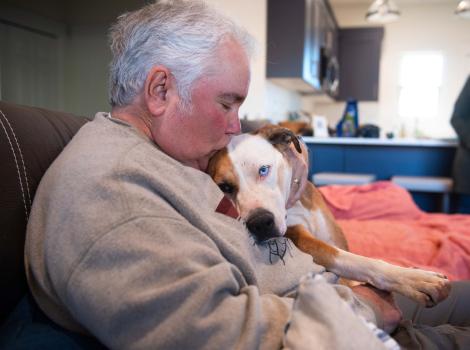
Standing on the front stoop with their oxygen tanks, Floyd and Diane laugh heartily at their dogs' excitement. Pam has known the couple since 1996, when they first approached Animal Care Network (ACN) for help with their dog and two cats. Appreciating how well the retired couple cared for their pets, Pam gladly obliged. ACN provided them with some food and had their animals sterilized at very little cost. Since then, Floyd and Diane call Pam whenever they need a little extra help feeding or getting medical care for the many animals they've had over the years. ACN has, in fact, made it possible for the couple to keep their pets.
Inside, Pam trims the dogs' nails while Floyd and Diane sit next to the fire and talk about how they ended up with the five dogs they currently have. Three of them - two Chihuahuas named Paco and Taco and a poodle named Candy - came from a relative who died in 2006. The two others, T.J. and Bullet, were rescues. As they talk, Paco and Taco prance across the back of the couch. Floyd and Diane look at the animals with joy; it's obvious that their dogs bring them a lot of pleasure.
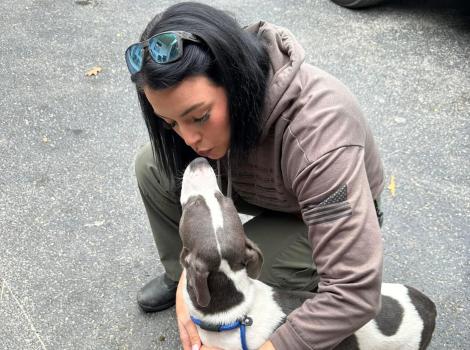
A big part of Pam's work, however, involves feeding and caring for the hundreds of dogs, mostly pit bull terriers, who are chained up in Pontiac's backyards and grossly neglected by their owners. Since the police (or what's left of the department in Pontiac) refuse to intervene in even the most egregious animal cruelty cases, another big part of Pam's work involves trying to educate people who neglect their dogs and to encourage them to take better care of them - to at least spay and neuter them. "These dogs are more like backyard accessories than pets," Pam says.
In a city with over 20 percent unemployment, a dwindling police force and no functioning animal control, there would be little, if any, hope for the animals in Pontiac if it weren't for Pam and ACN.
Helping people like Floyd and Diane, who take good care of their animals, injects Pam's job with some much-needed levity, taking a little of the weight from the load Pam and ACN bear in bringing relief to the animals of Pontiac.
Back in the minivan after her visit with Floyd and Diane, Pam is in a buoyant mood. "They are very poor people with very little, but they have huge hearts and you feel pretty good when you leave their home," she says.
Every evening, Pam draws up a list of dogs and families she needs to check up on the following day - to make sure the dogs have enough food, fresh water and proper shelter, and to make sure they are in decent shape and up to date on their shots. With the parvovirus running rampant through Pontiac, Pam is vigilant about telling dog owners, especially those with puppies, to get their dogs inoculated.
Next on her list today is Andrea Calkins, another person who makes Pam's job much easier. Andrea has herself become a onewoman rescue, taking 15 stray cats into her home. Pam has made sure that Andrea isn't in over her head with the number of animals she has rescued and cares for. And it's apparent, by how clean the house is and how little it smells of cats, that Andrea is doing a formidable job of caring for so many animals. But it wouldn't be possible without Pam. "She helps me with everything I would possibly need help with," Andrea says.
Everyday acts of kindness
ACN volunteers hit the streets of Pontiac every weekend, but Pam hits the streets every day, and has done so since 1994. Rarely has she taken a day off. Though she's not from Pontiac (she's from nearby Royal Oak) and has never resided there, she has adopted the city as her own. And people reach out to her constantly - it's not unusual for her to receive 150 or more phone calls in a single day, often from a concerned neighbor, postal worker or utility worker reporting an animal in distress or from a pet owner unable to come up with the money he needs to buy dog food that week. "Pam is the guardian angel of Pontiac's animals," says ACN volunteer Evan Deutsch.
Pam admits there are a lot of mornings when Pontiac is the very last place on earth she wants to be. But then her phone starts ringing with requests - sometimes pleas - for help, and before long she's in the city providing that help. "Nobody else is going to do it, so we have to do it," she says.
Her hair tamed under a baseball hat, Pam comes across initially as no-nonsense - a veteran in the world of animal rescue. It soon becomes apparent after meeting her that whatever emotional calluses she's developed by working in this downtrodden city are not so thick. Even though she sees abuse and neglect on a daily basis, she still turns indignant at the way people treat their animals and at the system that allows it to happen. Every week for the past several years, Pam has compiled a list of animal cruelty and neglect complaints and emailed that list to Pontiac's mayor, chief of police, animal control supervisor and the city council members who represent the neighborhoods from which the complaints stem. Even though they rarely respond, she keeps sending the list anyway.
"I have received a couple questions from the pertaining council person," she says with a tinge of anger, "but never any results or feedback on the complaints. Never."
The police, however, often rely on Pam to take care of the animals they come across when responding to other crimes, often violent ones. It's safe to say that Pam has seen the worst of the worst. Nonetheless, she maintains a sense of humor, sometimes a black sort of humor, allowing herself to laugh when the absurdity or futility of a situation makes itself all too plain - a frequent occurrence in Pontiac.
Before becoming ACN's manager, Pam volunteered and worked for 12 years at Michigan Animal Rescue, a no-kill shelter in Pontiac (a place where she continues to take animals she and her volunteers rescue). Before turning full time to animal rescue, she was an office manager at General Mills. She volunteered at the shelter for the 10 of her 25 years at General Mills.
"On our way to and from the shelter, we would look around and see all of these stray dogs and cats, and dogs in backyards, and animals with no shelter - just a huge need for some street work [to be] done in the city," Pam says. "So, about four or five of us volunteers decided we should start a program to help the outdoor animals in Pontiac."
While still working for General Mills, she would drive almost daily into Pontiac during her lunch break to check up on animals she had previously spotted on the streets. Pam took many of those animals back with her to work.
She remembers the first time she drove through Pontiac to help animals. It was during a snowstorm in the middle of winter, and they found a puppy stuck in a snow bank. "That was the first dog I rescued, and that was it," she says. "I had this automatic thought that this was something I could be good at."
The same year that ACN started up, General Motors shut down one of its plants in Pontiac. With it went 1,800 jobs. The plant is gone, but its concrete foundation, covering several blocks and surrounded with a chain-link fence, remains as a grim reminder of better times. In 2009, General Motors closed another plant in Pontiac, this one with 1,100 workers. Today the city is under financial receivership, and around 22 percent of the population lives below the poverty line. In such an economic climate, animals don't fare well.
But through it all, Pam, president and founder Marie Skladd, and ACN's other volunteers have somehow managed to actually improve the conditions for Pontiac's animals and to keep thousands of dogs and cats with their caring families. (As a No More Homeless Pets Network partner, ACN has signed on to help Best Friends bring about a time of No More Homeless Pets.)
Pam partially measures the progress ACN has made in 17 years by rectifying what one might consider a third-world problem. "When we first started driving the streets of Pontiac in 1994, we would see something like three packs of large-breed dogs, six to 12 dogs at a time," she says. "So we started trapping the dogs until we broke up all the packs."
Since 1994, she and her team at ACN have also rescued more than 12,500 dogs and cats, fixed more than 5,200 and vaccinated more than 17,500. They've also conducted more than 74,000 home wellness checks. Pam has done the lion's share of the work.
As the protector of animals in a city where many engage in dogfighting and deal in the illegal drugs and guns that go along with it, Pam has had her life threatened several times. She can usually tell who's involved in crime. "The only people who won't accept our help are the people who are doing something wrong," she says.
A godsend
As Pam drives down a derelict street on the north side of Pontiac, she points out a row of houses belonging to some of those people who won't accept her help - dogfighters. "We tend to stay away from those houses," she says.
Pam's friends call her "the phone book" because she knows the address and phone number for just about every person in Pontiac. She figures about 80 percent of Pontiac's 69,000 people know her, and vice versa. Because she's helped so many people in the city and garnered such a stellar reputation, Pam feels confident no one, except the dogfighters, would attempt to harm her.
Today she's paying a visit to Sam Dowe and his pit bull terrier Pinky, who live down the street from the dogfighters. When Sam first moved to the neighborhood, his dog at the time was stolen. Sam never got him back and never found out what happened to him. Given where Sam lives, he and Pam feared the worst.
Sporting dreadlocks and a Bob Marley T-shirt, Sam emerges from his house with Pinky to greet Pam, who comes bearing a big bag of dog food. Since Sam allowed Pam to have Pinky spayed, she is more than happy to give him all the assistance he needs in caring for his dog.
Sam knows, as do many of the people Pam helps, that ACN's generosity has its limits: If those in need refuse to have their dogs sterilized, ACN's help eventually fades. Sam has no interest in breeding Pinky and adding to the overpopulation problem. "I see so many
Next door to Sam are Deneko Howard and his three pit bull terriers. Pam has been helping Deneko for years. He doesn't have a car and there are no grocery stores within walking distance, so just having someone deliver some food for his dogs is a godsend. "I really appreciate it because there's nobody else helping animals," he says. Despite all the heartaches and headaches of the work, Pam and ACN's 10 or so volunteers soldier on, motivated by the good they're doing for the animals and for the people who genuinely love their pets but struggle to pay for their care. "You'll get some people who will call once, and they feel really ashamed to ask for help," Pam says. "And then when we get there and we help them, it's just really cool to see their reaction. We just seem to be at the right place at the right time a lot."
For more information about Animal Care Network, visit www.mi-aan.org. If you would like to donate to Animal Care Network, send a check to:
Animal Care Network
P. O. Box 566
Roseville, MI 48066